
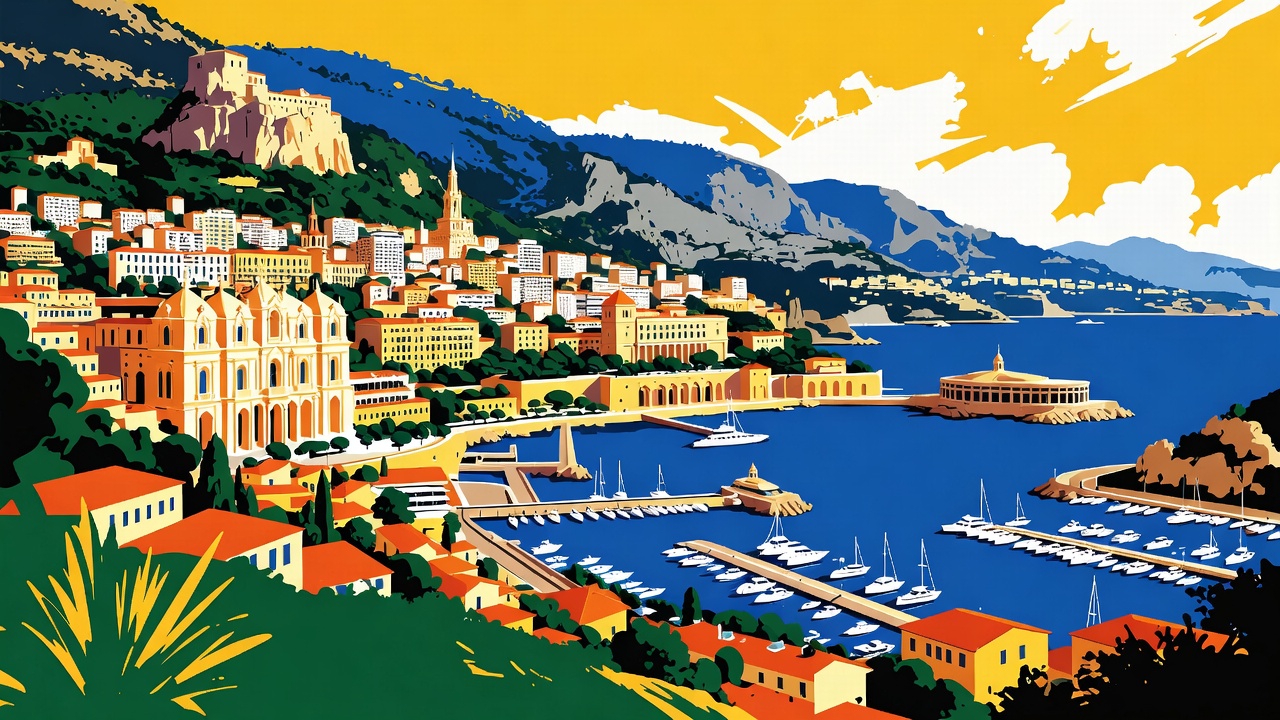
Monaco Residency: Gaining Entry to Europe’s Most Exclusive Tax Club
Why Billionaires Choose Monaco Over Dubai or Singapore
Roger Moore lived there for decades. Bono, of U2, maintains an apartment there. Lewis Hamilton relocated his tax residency there before he started winning championships. David Coulthard, Nico Rosberg, Jenson Button—virtually the entire Formula 1 elite at some point in their careers decides to move to Monaco. Not for the climate, though three hundred sunny days a year is an asset. Not for space—the entire principality covers two square kilometers, less than Warsaw’s Ursynów district. They choose Monaco for something simple: zero income tax while maintaining European living standards and political stability.
Monaco is a genuine private club—perhaps the smallest and most exclusive club in the world. The princely authorities don’t need your money. They already have more billionaires per square kilometer than any other place on Earth. The question is: Do you fit their vision of the principality?
And this is the fundamental difference. In most residency programs, the question is “Do you meet the requirements?” In Monaco, the question is “Are you the right kind of person for our principality?” It’s not merely a matter of money. It’s a matter of reputation, background checks, due diligence deeper than C.I.A. recruitment.
Zero Income Tax: What It Actually Means in Practice
When people say “Monaco has no income tax,” most think, “Great, I won’t pay tax on my salary.” But Monaco residency isn’t for people who earn salaries. It’s for people who earn from capital—dividends, capital gains, bond interest, royalties. Most ultra-wealthy Monaco residents hold the majority of their wealth outside the principality—in offshore trusts, Luxembourg funds, Swiss accounts, international holding companies. In Monaco, they keep only what’s needed to maintain residency and lifestyle: an apartment, an operating account, local companies if they conduct business from Monaco.
Since 1869, Monaco has levied no income tax on residents—with one crucial exception: French citizens. This isn’t a system error. It’s a deliberate clause forced by France in 1963, when it threatened to annex the principality if Monaco didn’t start taxing the French. Prince Rainier III chose the lesser evil. Today, if you’re a French citizen living in Monaco, you pay French income tax as if you lived in Paris. For all other nationalities? Zero.
Zero capital-gains tax. You sold stock bought for a million for ten million? The nine million in profit is yours, entirely. You don’t pay Poland’s nineteen-per-cent Belka tax. You don’t pay America’s twenty-per-cent long-term capital-gains tax. You don’t pay Germany’s thirty-per-cent short-term-gains tax. Zero. This is why fund managers, private-equity investors, wealthy traders relocate to Monaco. With returns measured in millions annually, the tax savings aren’t pennies—they’re millions of euros in difference yearly.
Zero tax on dividends and interest. Do you have a portfolio of dividend-paying stocks? A portfolio of corporate bonds? Structured products? All passive income is tax-free in Monaco. The only tax is any withholding tax in the source country (e.g., the fifteen-per-cent U.S. withholding tax on dividends, which you can partially recover through double-taxation treaties if you have the appropriate structure).
But careful—no income tax in Monaco doesn’t mean you don’t pay taxes anywhere. If you conduct operational business in another country (you have a factory in Poland, an office in London, an operating company in Germany), you’ll be taxed where that activity occurs. Monaco eliminates only the tax on your personal income as a resident. It doesn’t eliminate corporate income tax in countries where your companies actually operate.
Zero wealth tax—you pay no annual tax on wealth, net worth, or assets.
Inheritance Tax: When Monaco Does Collect
This is one area where Monaco isn’t a tax haven in pure form. Inheritance tax exists, but with key exemptions. Immediate family pays zero—transfers of wealth between spouses, from parents to children, from children to parents—all of this is free from inheritance tax.
Beyond the immediate family, however, Monaco does impose inheritance taxes, though at rates generally more favorable than those in major European countries. The system is designed to preserve dynastic wealth within families while ensuring that more distant relatives or unrelated beneficiaries contribute to the principality’s coffers.
The Real Cost of Entry
The popular narrative suggests that Monaco residency is simply a matter of having enough money. The reality is far more nuanced. Yes, financial capacity is necessary—but it’s merely the starting point, not the finish line.
The principality requires proof of financial self-sufficiency. In practice, this means demonstrating liquid assets sufficient to support yourself without employment in Monaco. The unofficial threshold hovers around five to ten million euros in liquid assets, though this isn’t formally published. The authorities want assurance that you won’t become a burden on Monaco’s social systems and that you can maintain the lifestyle expected of a Monaco resident.
But money alone won’t secure residency. Monaco conducts extensive background checks examining your professional history, business reputation, potential political connections, and any criminal record. They’re not merely checking boxes—they’re evaluating whether you align with the principality’s carefully cultivated image. A tech entrepreneur who sold a successful startup? Welcome. A cryptocurrency trader whose fortune’s origins are murky? Likely not.
The housing requirement presents another substantial barrier. To obtain residency, you must secure housing in Monaco—either purchasing or renting. Given that the average price per square meter exceeds fifty thousand euros, and even modest apartments can cost several million, this represents a significant capital commitment. Rental isn’t necessarily cheaper; annual rents for suitable properties can easily reach six figures.
The Application Process: Patience and Precision
Unlike citizenship-by-investment programs that promise passports in months, Monaco residency is a marathon requiring patience, meticulous documentation, and often professional guidance.
The process begins with securing housing, as you cannot apply for residency without a Monaco address. Once housing is secured, you compile an extensive dossier: passport and identity documents, proof of address in Monaco, comprehensive financial documentation demonstrating self-sufficiency, bank references (often requiring minimum deposits of five hundred thousand to one million euros), a detailed curriculum vitae, police clearance certificates from all countries where you’ve resided, and medical certificates.
The authorities then conduct their due diligence, which can take months. They verify every claim, check every reference, examine your business dealings and associations. If anything raises concerns—unexplained wealth, problematic business partners, legal issues anywhere in the world—your application faces rejection or indefinite delay.
The entire process typically requires six months to a year, sometimes longer for complex cases. And unlike many jurisdictions, there’s no guarantee of approval even if you meet all stated requirements. Monaco retains discretionary authority to decline applications without detailed explanation.
Tax-Residency Certificate: The Key to International Recognition
Obtaining Monaco residency is one thing; securing international recognition of your tax status is another. Many countries—particularly those with significant taxation—scrutinize claims of Monaco tax residency carefully, seeking to ensure you’re not merely maintaining a convenience address while actually residing elsewhere.
Monaco issues a tax-residency certificate (certificat de résidence fiscale) to residents who can demonstrate they’ve spent at least a hundred and eighty-three days in the principality during the year. This certificate costs six hundred euros and remains valid for one year.
But possessing the certificate doesn’t automatically insulate you from taxation elsewhere. Your former country of residence may challenge your Monaco residency, particularly if you maintain significant ties—family, business operations, property—in that country. The burden of proof increasingly falls on the taxpayer to demonstrate genuine relocation, not merely paper residency.
The French Exception: When Zero Means Forty-Five
The Franco-Monegasque convention of 1963 represents Monaco’s most significant compromise of its tax-haven status. Under this agreement, French citizens residing in Monaco remain subject to French taxation as if they lived in France. For French nationals, Monaco offers no tax advantages whatsoever.
This wasn’t voluntary. In the early nineteen-sixties, French President Charles de Gaulle, concerned about wealthy French citizens relocating to Monaco to avoid taxation, essentially threatened economic strangulation of the principality. Prince Rainier III, recognizing Monaco’s dependence on France for virtually all necessities—food, water, electricity—had little choice but to acquiesce.
The irony is that this exception enhances Monaco’s legitimacy with other nations. By demonstrating willingness to coöperate with France’s tax interests, Monaco positions itself as a responsible jurisdiction rather than a rogue tax haven, making it more difficult for other countries to justify similar pressure.
Who Monaco Actually Makes Sense For
Monaco residency represents an optimal choice for a specific profile: individuals whose wealth derives primarily from capital rather than active income, who possess substantial liquid assets (realistically, ten million euros or more), who value European lifestyle and proximity to major cities, who can genuinely relocate their center of life to the principality, and whose wealth has clean, documentable origins.
It makes less sense for entrepreneurs whose businesses require physical presence elsewhere, professionals whose careers demand mobility, anyone uncomfortable with intense scrutiny of their financial history, French citizens (obviously), or those seeking a quick, transactional residency solution.
Monaco isn’t selling residency—it’s granting admission to a club. The distinction matters. Unlike citizenship-by-investment programs where the transaction is relatively straightforward (pay the fee, get the passport), Monaco evaluates holistically. They’re asking not merely “Can you afford to live here?” but “Do we want you living here?”
For those who fit the profile and successfully navigate the process, Monaco delivers on its promise: a European lifestyle, political stability, security, and—most importantly—zero taxation on personal income and capital gains. In a world of increasing tax scrutiny and decreasing privacy, that combination remains extraordinarily valuable.
But the price of entry, both financial and reputational, ensures that Monaco remains what it has always been: not a tax haven for the masses but a private sanctuary for a select few who can afford—and withstand—the scrutiny required for admission.
The law firm Kancelaria Prawna Skarbiec offers comprehensive advisory services regarding Monaco residency applications, tax optimization for Monaco residents, and international structuring in full compliance with C.R.S., F.A.T.C.A., and local regulations. We guide clients through the entire process—from initial eligibility assessment through documentation preparation to securing residency—while ensuring full compliance with both Monaco requirements and international tax obligations.

Robert Nogacki – licensed legal counsel (radca prawny, WA-9026), Founder of Kancelaria Prawna Skarbiec.
There are lawyers who practice law. And there are those who deal with problems for which the law has no ready answer. For over twenty years, Kancelaria Skarbiec has worked at the intersection of tax law, corporate structures, and the deeply human reluctance to give the state more than the state is owed. We advise entrepreneurs from over a dozen countries – from those on the Forbes list to those whose bank account was just seized by the tax authority and who do not know what to do tomorrow morning.
One of the most frequently cited experts on tax law in Polish media – he writes for Rzeczpospolita, Dziennik Gazeta Prawna, and Parkiet not because it looks good on a résumé, but because certain things cannot be explained in a court filing and someone needs to say them out loud. Author of AI Decoding Satoshi Nakamoto: Artificial Intelligence on the Trail of Bitcoin’s Creator. Co-author of the award-winning book Bezpieczeństwo współczesnej firmy (Security of a Modern Company).
Kancelaria Skarbiec holds top positions in the tax law firm rankings of Dziennik Gazeta Prawna. Four-time winner of the European Medal, recipient of the title International Tax Planning Law Firm of the Year in Poland.
He specializes in tax disputes with fiscal authorities, international tax planning, crypto-asset regulation, and asset protection. Since 2006, he has led the WGI case – one of the longest-running criminal proceedings in the history of the Polish financial market – because there are things you do not leave half-done, even if they take two decades. He believes the law is too serious to be treated only seriously – and that the best legal advice is the kind that ensures the client never has to stand before a court.